Barred Owl call
Northern spotted owls are medium sized brown owls characterized by a dark brown face with small white spots. They have circles of dark brown around each dark brown eye. They have a yellowish green bill and their legs and feet are fully feathered.
The northern spotted owl was listed as a threatened species in northern California, Oregon and Washington by the United States Fish and Wildlife Service in 1990 citing loss of old-growth habitat as the primary threat.
Old Growth Forests are forests that have attained great age without significant disturbance and therefore has unique ecological features. These forests have a complex structure characterized by large(an understatement!), live and dead trees, distinctive habitats and a diverse group of plants, fungi, and animals.
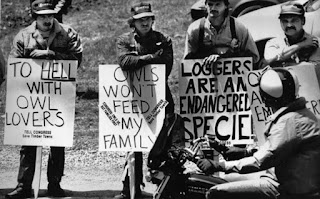
Logging in national forests containing the northern spotted owl was stopped by court order in 1991. I cant believe the logging in these ancient forests continued 21 years after the first Earth Day was celebrated.
The 1991 court order pitted loggers and small sawmill owners against environmentalists. One study conducted at the University of Wisconsin–Madison(Yay for UWM) by environmental scientists argued that logging jobs had been in a long decline and that environmental protection was not a significant factor in job loss.
The logging industry, in response to bad publicity, started the Sustainable Forestry Initiative. The industry claims to promote sustainable forestry management, improved forestry practices and responsible purchasing of forest products. Environmentalists view the Spotted Owl as an "indicator species," a kind of "canary in a coal mine" whose preservation has created protection for an entire threatened ecosystem.(Old Growth Forests) The "canary in the coal mine" originated in early coal mines that did not have ventilation systems. Legend has it that miners would bring a caged canary into the mines. Canaries are especially sensitive to methane and carbon monoxide, which made them ideal for detecting any dangerous gas build-ups. As long as the bird kept singing, the miners knew their air supply was safe. A dead canary signaled an immediate evacuation.
One group used as an indicator species today are amphibians, which includes frogs, toads and salamanders. Their skin is porous and absorbs gases and liquids so amphibians at all stages are sensitive to changes in the environment, especially pollution that may be in the atmosphere, water or soil.
Protection of the Northern Spotted Owl, under both the Endangered Species Act and the National Forest Management Act, has led to significant changes in forest practices in the northwest. The purpose of the ESA is to protect species in jeopardy and the ecosystems they depend on. The purpose of the National Forest Management Act is to have the forest service use a systematic and multi-faceted approach to resource management. In other words, the forest service had to begin using sustainable methods when working within our countries forests. It also provided for public involvement in preparing and revising forest plans. President Clinton's Northwest Forest Plan of 1994 was designed primarily to protect owls and other species dependent on old-growth forests while ensuring a certain amount of timber harvest.
In 2004 the U.S. Fish and Wildlife Service reaffirmed that the Spotted Owl remained threatened, but the recognized cause of endangerment had changed. Spotted Owls are now threatened by the invasion of barred owls into their range and habitat. Since the 1960's, Barred Owls have been expanding their range westward from the eastern United States. When Spotted Owls and Barred Owls share the same environment, the Barred Owls are more aggressive and out-compete the Spotted Owl. They are owl bullies. They have also been known to interbreed, creating hybrids that will threaten the species. ("sparred owl" or "botted owl").
My interest in the plight of the Spotted Owl started years ago when I discovered a fascinating book that I read a book to my second graders every year titled, "There is an Owl in the Shower".
In a nutshell, the father in the story is a "cutter" and loses his job when the government orders logging to stop in order to save the Spotted Owl. He is very angry and blames the owls and the people in town that he terms, "owl lovers". His young son takes on his anger and rides to the forest each day to shoot owls. During a storm, an owlet falls at his feet and he takes it home. That is when the adventure begins. The owlet is a Spotted Owl but they don't realize it because juvenile Spotted Owls don't have spots. The story covers so many topics that it takes us almost the entire school year to get through it.
The town in the book is fictional but it could have been any one of the small towns that are within bicycle riding distance from the magical ancient forests that I walked through. It was so exciting for me to put myself in that place. I cannot wait to read the book this school year!
Unfortunately, despite my owling calls, I was not able to see one of these beautiful owls in its habitat, although one did fly in front of our windshield as we were driving through the forest at night.
Court battles are still ensuing over the logging of these beautiful forests and the future of the Northern Spotted Owl. After being in these forests, I cannot believe that anyone would take a chainsaw to these trees. It boggles my mind that trees deemed "ancient" wouldn't be protected at all costs.




I love, love, love this definition of a wilderness. It comes from the "Wilderness Act" signed into law in 1964.
In 2004 the U.S. Fish and Wildlife Service reaffirmed that the Spotted Owl remained threatened, but the recognized cause of endangerment had changed. Spotted Owls are now threatened by the invasion of barred owls into their range and habitat. Since the 1960's, Barred Owls have been expanding their range westward from the eastern United States. When Spotted Owls and Barred Owls share the same environment, the Barred Owls are more aggressive and out-compete the Spotted Owl. They are owl bullies. They have also been known to interbreed, creating hybrids that will threaten the species. ("sparred owl" or "botted owl").
My interest in the plight of the Spotted Owl started years ago when I discovered a fascinating book that I read a book to my second graders every year titled, "There is an Owl in the Shower".
In a nutshell, the father in the story is a "cutter" and loses his job when the government orders logging to stop in order to save the Spotted Owl. He is very angry and blames the owls and the people in town that he terms, "owl lovers". His young son takes on his anger and rides to the forest each day to shoot owls. During a storm, an owlet falls at his feet and he takes it home. That is when the adventure begins. The owlet is a Spotted Owl but they don't realize it because juvenile Spotted Owls don't have spots. The story covers so many topics that it takes us almost the entire school year to get through it.
The town in the book is fictional but it could have been any one of the small towns that are within bicycle riding distance from the magical ancient forests that I walked through. It was so exciting for me to put myself in that place. I cannot wait to read the book this school year!
Unfortunately, despite my owling calls, I was not able to see one of these beautiful owls in its habitat, although one did fly in front of our windshield as we were driving through the forest at night.
Court battles are still ensuing over the logging of these beautiful forests and the future of the Northern Spotted Owl. After being in these forests, I cannot believe that anyone would take a chainsaw to these trees. It boggles my mind that trees deemed "ancient" wouldn't be protected at all costs.


“A wilderness, in contrast with those areas where man and his own works dominate the landscape, is hereby recognized as an area where the earth and its community of life are untrammeled by man, where man himself is a visitor who does not remain."
Click here to learn more about this initiative and the labels to look for when shopping for wood or wood products: Sustainable Initiative labels
F.Y.I. Old Growth Forests in Wisconsin...
| Wisconsin | Apostle Islands National Lakeshore[ | 1,500 acres | ||
| Wisconsin | Chequamegon-Nicolet National Forest | |||
| Wisconsin | Namekagon Barrens | 4,000 acres |


